
The BeEST Experiment
Neutrino physics with superconducting quantum sensors.
We study what tiny nuclear recoils can reveal about the neutrino.
The science & our approach · Inside the sensor · Further reading
What a nuclear recoil can tell us
As spokesperson for BeEST, I work with an international collaboration to investigate neutrinos through the recoil of atoms after radioactive decay.
We implant radioactive beryllium-7 directly into superconducting sensors. The energy left behind after electron capture allows us to search for heavy neutrino states and investigate the quantum properties of weak decay.
Published progress
Our measurements have placed laboratory limits on heavy-neutrino mixing in the 100–850 keV mass range. Recoil-width measurements have also constrained localization in electron capture, with implications for neutrino wavepackets that depend on the theoretical description of their production.
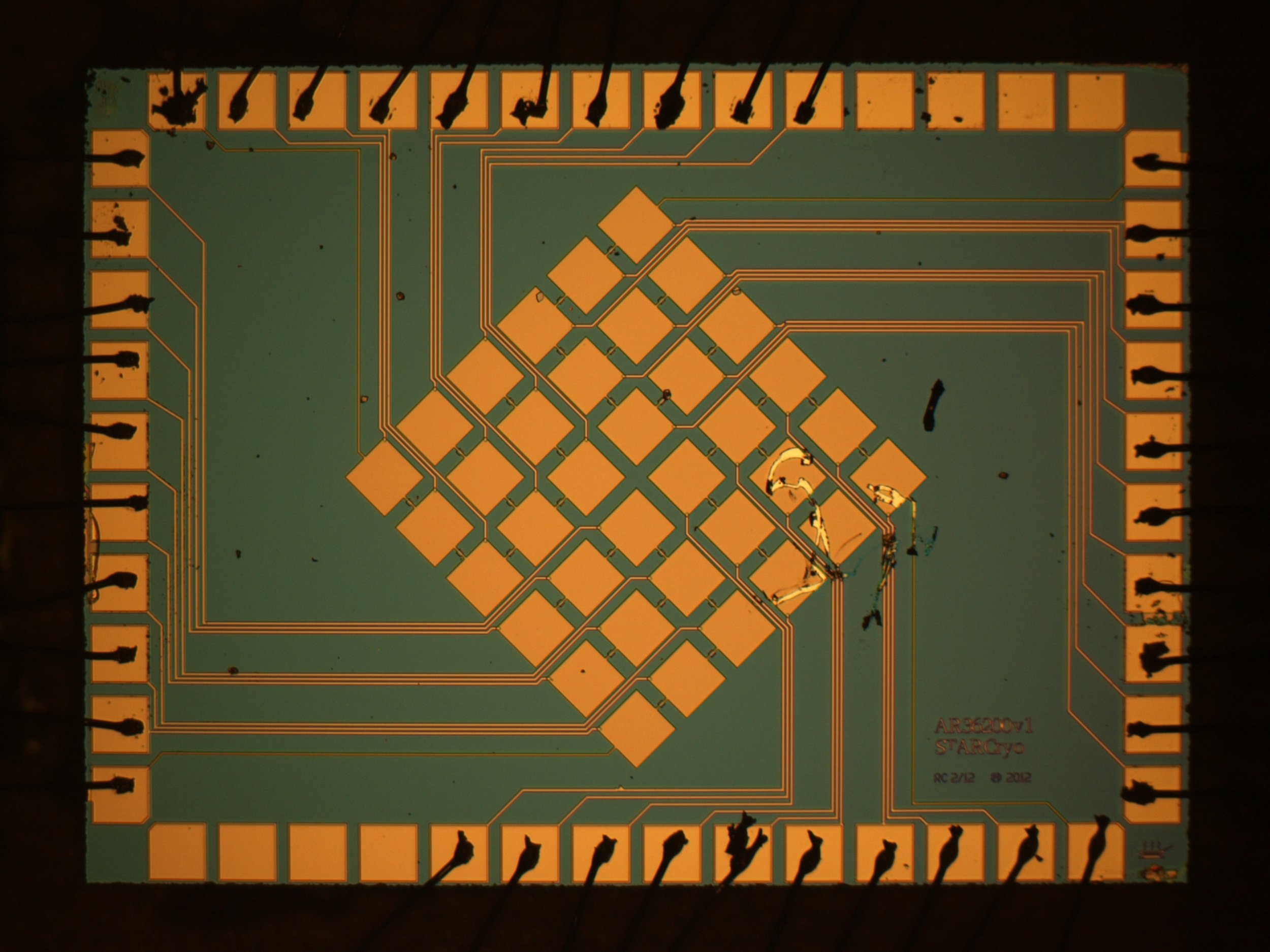
Phase III established measurements with a 36-pixel detector array and continuous data acquisition. Current work improves spectral analysis and our understanding of atomic and material effects, while preparing the next generation of measurements.
The source is inside the sensor
When beryllium-7 captures an electron, it becomes lithium-7 and emits an electron neutrino. The daughter atom recoils. For a given decay branch, a heavier neutrino changes the recoil energy and would introduce an additional feature in the measured spectrum.
Our superconducting tunnel junctions contain the radioactive atoms and measure the deposited energy. That energy breaks Cooper pairs, creating quasiparticles whose tunnelling produces an electrical signal.
Atomic relaxation, electronic excitations and the surrounding material also shape the spectrum. Understanding those contributions is essential to a sensitive search.
Below: a 36-pixel superconducting tunnel-junction array and a detector close-up.

Continuing the work at Queen’s
Our team is developing cryogenic and detector infrastructure at Queen’s University for future BeEST measurements.
This work depends on close collaboration in isotope production and implantation, superconducting detectors, precision calibration and spectral modelling.
Selected publications
The BeEST Experiment: Searching for Beyond Standard Model Neutrinos Using ⁷Be Decay in STJs
K. G. Leach and S. Friedrich, Journal of Low Temperature Physics 209, 796–803 (2022).
Limits on the Existence of Sub-MeV Sterile Neutrinos from the Decay of ⁷Be in Superconducting Quantum Sensors
S. Friedrich et al., Physical Review Letters 126, 021803 (2021).
Direct experimental constraints on the spatial extent of a neutrino wavepacket
J. Smolsky et al., Nature 638, 640–644 (2025).
Signal processing and spectral modeling for the BeEST experiment
I. Kim et al., Physical Review D 111, 052010 (2025).