Research
Rare isotopes. Quantum sensors. Fundamental questions.
We study what nuclear decay can tell us about neutrinos, the weak interaction and the structure of matter. Our experiments range from sensors that fit on a tabletop to international collaborations at radioactive-beam and underground facilities.
-
BeEST: neutrino physics
With BeEST, we investigate neutrinos using superconducting sensors and beryllium-7 decay, searching for heavy partners and probing the quantum physics of their production.
-
SALER: precision weak physics
With SALER at FRIB, we combine rare-isotope beams and superconducting sensors to measure nuclear recoil and test the weak interaction with precision.
-
Levitated optomechanics
We are developing levitated particles as momentum sensors, exploring how tiny kicks from nuclear decay could reveal particles that escape direct detection.
-
XLZD: double-beta decay
Our work with XLZD focuses on neutrinoless double-beta decay: a search that tests whether neutrinos are their own antiparticles.
-
Testing quark mixing
Precision nuclear decays test the consistency of quark mixing, combining experimental measurements with nuclear-structure and radiative corrections to probe the weak interaction.
-
Atomic–nuclear coupling
Highly charged radioactive ions let us investigate how electrons and nuclei exchange energy, and how an atom’s electronic environment can influence nuclear transitions.
-
Nuclear two-photon decay
Rare transitions that emit two photons provide access to transition electromagnetic polarizabilities, offering a complementary view of excited-state structure in atomic nuclei.
Neutrinoless double-beta decay with XLZD
Could a neutrino be its own antiparticle?
Our work with XLZD connects precision nuclear-decay physics with the search for an extraordinarily rare process. In neutrinoless double-beta decay, a nucleus would emit two electrons without accompanying antineutrinos. Observing it would establish lepton-number violation and show that neutrinos have a Majorana component to their mass.
XLZD is a proposed underground liquid-xenon observatory. Its natural xenon target contains xenon-136, allowing the detector itself to serve as the source of candidate decays. The challenge is to identify a tiny signal while suppressing backgrounds from materials and other interactions.
XLZD collaboration · Published double-beta-decay sensitivity study
Testing quark mixing
Nuclear beta decay offers a precise test of the weak interaction.
We use rare-isotope measurements to test the consistency of quark mixing, described by the Cabibbo–Kobayashi–Maskawa (CKM) matrix. Decay rates, energies and correlations connect an experimental measurement to the up–down quark coupling, Vud.
We have pursued these questions with GRIFFIN and TITAN at TRIUMF. Extracting a reliable result requires careful nuclear-structure and radiative corrections, alongside close collaboration between experiment and theory. SALER’s recoil measurements at FRIB provide a complementary approach.
Atomic–nuclear coupling
How does an atom’s electronic environment change nuclear decay?
At the TITAN electron-beam ion trap at TRIUMF, we use highly charged radioactive ions to explore the connection between electrons and nuclei. Removing electrons gives us a controlled way to change the atomic environment and study its influence on nuclear transitions.
One particularly interesting process is nuclear excitation by electron capture (NEEC): an electron is captured into an atomic vacancy while the nucleus is excited. Establishing when and how this resonant process occurs remains an experimental question, requiring careful control of both the ionic charge state and the nuclear state.
Nuclear two-photon decay
Two photons can reveal a different view of the nucleus.
An excited nucleus can sometimes release its energy by emitting two photons in a single transition. This rare process gives access to transition electromagnetic polarizabilities, connecting the initial and final nuclear states through intermediate excitations.
We study these decays using GRIFFIN at TRIUMF. Carefully rejecting backgrounds and reconstructing the two photons lets us test nuclear-structure calculations through an observable that is difficult to reach in other ways.
Read the germanium-72 measurement · Publications
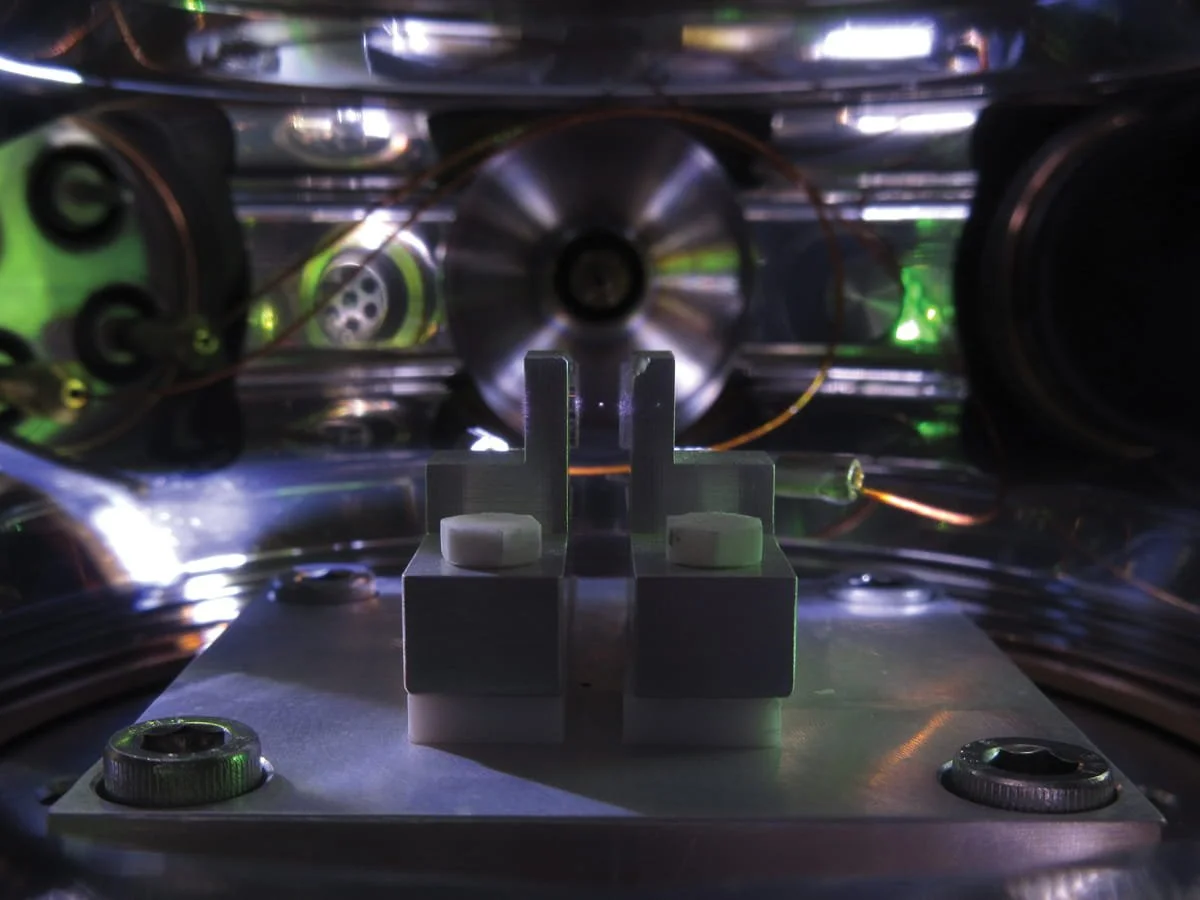
Opening photograph: levitated-optomechanics apparatus at Yale.
CONTACT
Philomena Abakah
Senior Program Officer – Research and Lab Operations
p.abakah@queensu.ca